Launching the European Project VOLABIOS: A Breakthrough in Early Diagnosis and Monitoring of Schizophrenia

[Thessaloniki, Greece – December 2024] – On January 1, 2025, the European Horizon Europe project, VOLABIOS (Validation and Comparative Multi-Omics Benchmarking of Fluid-Derived Volatilomics Biomarkers for the Prevention and Early Detection of Schizophrenia), officially begins its mission to revolutionize the early diagnosis and treatment of schizophrenia. This chronic mental illness affects approximately 1% of the global population—around 80 million people—and ranks among the top 15 causes of global disability, shortening life expectancy by 10-15 years. VOLABIOS aims to introduce advanced, cost-effective diagnostic tools to improve patients’ and families’ quality of life, reduce diagnostic errors by approximately 30%, and optimize treatment and monitoring strategies.
A Multidisciplinary Approach to Early Diagnosis
VOLABIOS utilizes advanced technologies to transform early schizophrenia diagnosis while striving to uncover the molecular mechanics of the disease. It integrates Multi-Omics approaches—genomics, proteomics, metabolomics, and transcriptomics—to provide a comprehensive understanding of the molecular changes driving schizophrenia. Mobile spectrometry (volatolomics) analyzes volatile organic compounds emitted by the body, offering a non-invasive diagnostic method. Artificial intelligence further enhances this framework by analyzing complex datasets to uncover patterns, correlations, and underlying mechanisms. Together, these technologies enable precise and rapid identification of chemical and biochemical signals serving as biomarkers for schizophrenia, improving diagnostic accuracy, reducing timelines, and paving the way for earlier interventions, deeper disease understanding, and better patient outcomes.
A Global Consortium for Groundbreaking Innovation
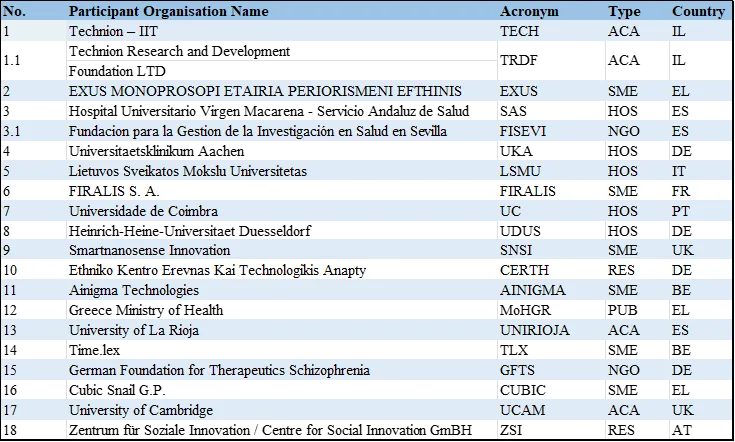
The VOLABIOS project brings together a multidisciplinary consortium of 18 partners (+2 affiliated) from 11 European countries, combining expertise in academia, clinical research, technology, public health, and policy-making. United by a commitment to innovation, the team integrates cutting-edge research with practical healthcare applications, developing advanced diagnostic tools and ensuring alignment with public health priorities. An advisory committee of internationally recognized experts in psychiatry and neuroscience provides strategic guidance, ensuring the project stays focused on enhancing early diagnosis and improving patient outcomes. This collaboration equips the VOLABIOS project with the resources and expertise for groundbreaking advancements in mental health diagnostics.
Research Phases and Clinical Impact
The project will progress in multiple stages, starting with a retrospective analysis of 9 million medical records, including 120,000 linked to schizophrenia. Following this, clinical research will involve 3,692 patients from six medical centers across Europe, with individuals being monitored frequently over a period of 18 to 36 months to assess longitudinal changes and validate findings. A blind study involving 1,000 participants will further validate biomarkers and assess their efficacy. The outcomes of VOLABIOS aim to improve global healthcare systems by introducing innovative diagnostic tools, establishing an open-access knowledge base, and supporting future research in diagnosing complex mental disorders.
CUBIC SNAIL’s Role in VOLABIOS
CUBIC SNAIL plays a crucial role in the VOLABIOS project, contributing its technical expertise to several essential components that ensure the project’s impact on policy, clinical decision-making, and public engagement.
- Policy-Making Tool for Schizophrenia (SZ)
CUBIC SNAIL is tasked with the technically developing an intelligent, evidence-based policy-making tool designed to support healthcare officials, researchers, and patient advocacy groups in shaping better strategies for SZ diagnosis and management. This tool will:
- Consolidate key SZ-related insights, including risks, socioeconomic impacts, and healthcare burden, into actionable data.
- Provide tailored recommendations for policymakers to support early intervention and personalized treatment approaches.
- Serve as a digital interface for evidence-based decision-making, aligned with the latest research and clinical findings.
By equipping decision-makers with reliable, up-to-date information, this tool ensures that the outcomes of the VOLABIOS project translate into meaningful, real-world health policies.
- Graphical User Interfaces (GUIs) for the Clinical Decision Support System (CDSS)
CUBIC SNAIL contributes to the development of intuitive and functional user interfaces for the VOLABIOS Clinical Decision Support System (CDSS). These GUIs are designed with healthcare professionals in mind, focusing on:
- Ease of Use: Ensuring seamless integration into clinical workflows through user-friendly dashboards and tools.
- Data Visualization: Presenting complex data on SZ biomarkers and predictions in clear, actionable formats.
- AI Integration: Displaying AI-driven recommendations and stratifications to assist clinicians in diagnosing and managing SZ with precision.
This system not only supports clinical decision-making but also enhances healthcare professionals’ confidence in implementing VOC biomarker technologies.
- Digital Outreach: Website and Social Media Presence
CUBIC SNAIL is also responsible for creating and managing the VOLABIOS project’s online presence, including:
- Website Development: Establishing an engaging and informative website that serves as the central hub for project updates, deliverables, and stakeholder engagement.
- Social Media Strategy: Curating content to raise awareness about SZ, disseminate research findings, and foster interaction with broader audiences, including patients, caregivers, and the scientific community.
- Outreach Analytics: Monitoring engagement metrics to optimize communication strategies and ensure maximum visibility and impact.
By leveraging these digital platforms, CUBIC ensures that VOLABIOS reaches its intended audiences effectively, promoting the project’s goals and fostering collaboration.
Impact of CUBIC’s Contributions
CUBIC’s work is central to bridging the gap between research, clinical practice, and public policy. Through its policy-making tools, user-focused interfaces, and strategic digital outreach, CUBIC enables the VOLABIOS project to:
- Influence health policies for SZ prevention and early diagnosis.
- Facilitate the adoption of advanced diagnostic tools by healthcare professionals.
- Increase public awareness and engagement with mental health innovations.
Key facts
- Start date: 01 January 2025
- Duration: 4.5 years (54 months)
- Funding: € 8,000,000
- Partners: 18 (+2 affiliated)
- Project Coordinator: Technion Prof. Hossam Haick
- Email: [email protected]
List of Participants
See every partner on the VOLABIOS project page.